Energy Monitoring for Smart Homes: What to Measure Before Buying
Energy monitors promise to show where your electricity goes, but most people buy the wrong resolution for their goal and end up with pretty graphs they never act on. Here is how to decide what to measure before you spend a cent.
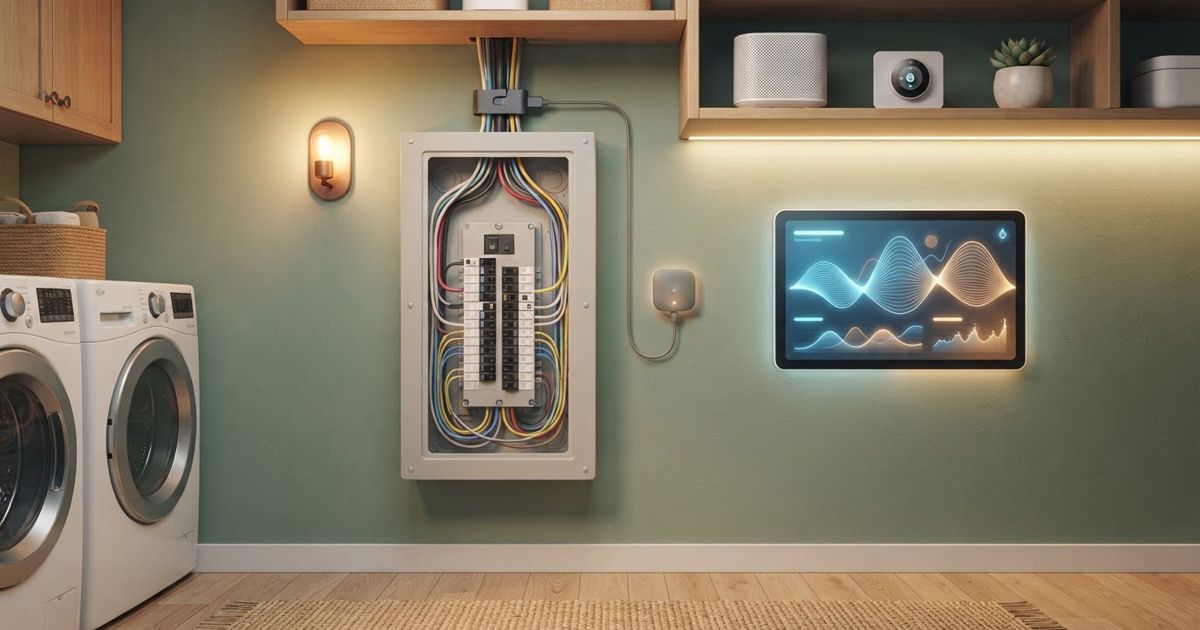
Table of contents
- Get clear on your goal first
- The three levels of measurement
- Resolution and sampling matter more than you think
- Measure the numbers that actually change behavior
- A quick comparison to frame the decision
- Don't overlook the boring practicalities
- Pair monitoring with the devices most worth watching
- The bottom line
Energy monitoring is one of the few smart home upgrades that can genuinely pay for itself — but only if you buy the right level of detail for the question you are trying to answer. Most disappointment comes from a mismatch: someone wants to know whether their old fridge is worth replacing, then buys a whole-home monitor that can only show a single blended number. Before you shop, decide what you actually need to measure.
Get clear on your goal first
Energy monitors answer different questions at different price points. Name your goal before you look at hardware:
- "Is my total usage trending up or down?" You need whole-home totals over time.
- "Which big appliance is eating my bill?" You need per-circuit or device-level detail.
- "Is this one gadget worth leaving plugged in?" You need a single smart plug with metering.
- "Am I using power when it's cheapest?" You need time-of-use awareness, not just totals.
Almost every buying mistake is really a goal that was never pinned down. Write yours in one sentence, then match the tool to it.
The three levels of measurement
Energy monitoring hardware falls into three tiers, and they are not interchangeable.
Whole-home monitors attach at your electrical panel and measure everything flowing into the house. They are the cheapest way to see your total footprint and spot daily and seasonal patterns. Their weakness is granularity: on their own, they show one big number, and figuring out what caused a spike is guesswork.
Circuit-level monitors add sensors to individual breakers. Now you can see the water heater, the oven, the car charger and the HVAC as separate lines. This is the sweet spot for anyone serious about cutting a bill, because it tells you where to act. It costs more and usually wants installation inside the panel.
Plug-level meters are smart plugs that report the consumption of whatever is plugged into them. They are perfect for a single suspect device — a space heater, an old fridge, a gaming PC, an aquarium. They cannot see anything hardwired, like your oven or central heating.
Many people end up with a combination: a whole-home monitor for the big picture and a couple of smart plugs for specific offenders.
Resolution and sampling matter more than you think
Two monitors can both claim to measure energy and give wildly different usefulness. The differences hide in how often and how finely they sample.
- Update frequency — a monitor that refreshes every few seconds lets you watch a device turn on in real time; one that reports every 15 minutes only shows blocks.
- Historical granularity — can you look back at a single minute last Tuesday, or only at daily totals? Fine history is what lets you catch an intermittent problem.
- Device disaggregation — some whole-home monitors try to guess individual appliances from the panel signal. Treat this as a bonus, not a promise; accuracy varies and depends heavily on your specific loads.
If your goal is behavior change, favor frequent updates and detailed history. If you only want a monthly trend, you can save money and ignore high-resolution features.
Measure the numbers that actually change behavior
A monitor is only useful if it surfaces data you will act on. Before buying, ask whether the device makes these visible and easy to read:
- Standby and always-on load — the baseline your home draws when "nothing" is running. This is often the most surprising and actionable number.
- Peak draw moments — when your usage spikes, and what is likely running then.
- Cost, not just kilowatt-hours — if you can enter your rate, the display becomes money instead of an abstract unit, which is far more motivating.
- Time-of-use context — if your utility charges more at certain hours, seeing usage against those windows tells you what to shift.
If a monitor only shows a single lifetime total, it will end up ignored. You want something that answers "what changed and what did it cost."
A quick comparison to frame the decision
| If you want to… | Buy this level | Watch out for |
|---|---|---|
| See total home trends | Whole-home monitor | Can't isolate appliances alone |
| Find the biggest culprit | Circuit-level monitor | Panel install, higher cost |
| Judge one device | Smart plug meter | Misses hardwired loads |
| Shift usage to cheap hours | Any monitor with time-of-use view | Needs your rate schedule entered |
Don't overlook the boring practicalities
Hardware fit is where projects stall. Before buying, check:
- Panel compatibility and space — circuit monitors need room and the right sensor size for your wiring. If you are unsure, this is the one area where an electrician is worth it.
- Where the data lives — cloud dashboards are convenient but tie your history to an account and a subscription; local options keep it in your hands. Our piece on local control versus cloud smart homes covers the tradeoff.
- Whether it integrates — if you want automations ("notify me when standby load jumps"), confirm the monitor exposes its data to your platform rather than trapping it in one app.
Pair monitoring with the devices most worth watching
Monitoring tells you where the energy goes; the payoff comes from acting on it. Heating and cooling almost always top the list, which is why a smart thermostat is often the highest-impact companion purchase. Once you can see a circuit's real draw, you can decide whether a device is worth replacing, rescheduling, or simply unplugging.
The bottom line
Buy for the question, not the graph. Decide whether you want the whole-home trend, the per-circuit truth, or a verdict on one gadget, then choose the cheapest tier that answers it with enough resolution to act on. A modest monitor you check and respond to beats an elaborate one you install and forget. If you are still building out the basics, our guide to smart home devices for beginners will help you sequence purchases sensibly.